Every commercial property owner eventually faces the same question: keep paying small, predictable amounts to maintain the building, or wait for something to break and fix it then? The preventive vs reactive maintenance debate sounds philosophical, but it is really a math problem. Labor, downtime, and emergency premiums all behave differently depending on which approach you choose, and the gap widens the larger and busier your facility is.
What Preventive and Reactive Maintenance Actually Mean
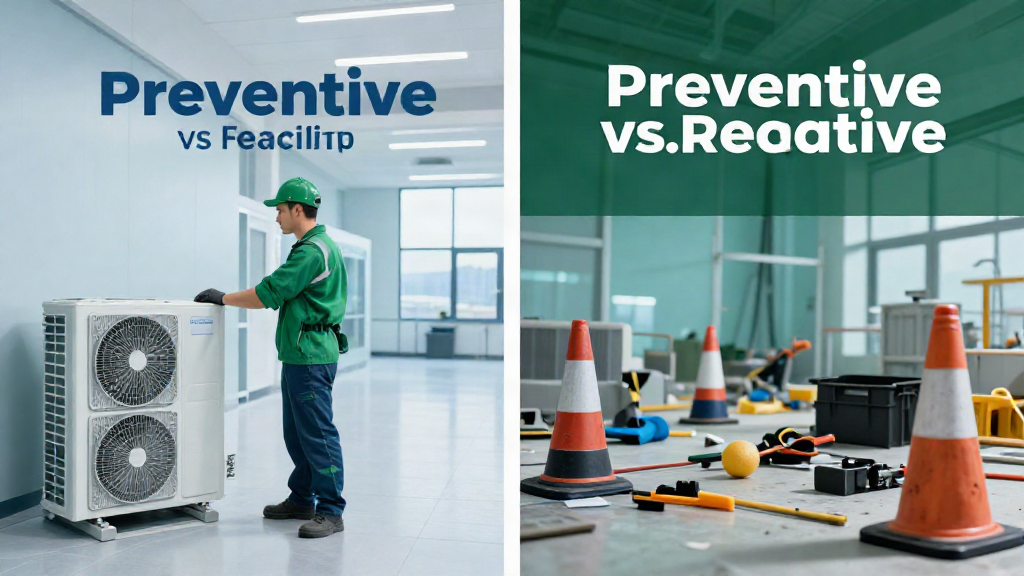
Reactive maintenance, sometimes called run-to-failure, means you repair equipment only after it stops working. A rooftop unit fails in July, you call someone, you pay whatever the emergency rate is, and the building adapts around the outage. It requires no planning, no schedule, and no upfront spend.
Preventive maintenance flips the logic. You service assets on a defined cadence, inspect belts, filters, seals, pumps, and electrical panels before they fail, and replace wear parts on a timetable rather than a breakdown. The work is planned, so it happens during slow hours at standard rates. The trade is a steady, budgeted cost instead of an unpredictable one.
The Real Cost Comparison: Labor, Downtime, and Emergency Premiums
Comparing the two on the sticker price of a single repair is misleading. The honest comparison spreads the cost across a year and looks at three categories.
Labor and parts
Reactive repairs almost always cost more per incident. Emergency call-outs carry after-hours rates, technicians arrive without the right part on the truck, and a second trip becomes a third. Planned service visits bundle multiple checks into one trip, so the labor per asset drops, and parts get ordered at normal prices instead of whatever the supply house charges at 11 p.m.
Downtime
This is where the numbers separate fastest. A failed HVAC unit in a retail space affects customers, staff, and sometimes compliance. A failed elevator or a backed-up drain can shut part of a building down entirely. Downtime carries costs that never appear on a maintenance invoice: lost sales, displaced tenants, overtime for staff managing the situation, and reputational damage that lingers well after the repair.
Emergency premiums
Reactive maintenance is essentially a series of emergencies, and emergencies are priced as such. A planned program converts those events into scheduled work, which removes the premium almost entirely. The savings are not just the rate difference, they are the avoided overtime, expedited shipping, and rushed decisions that come with every unplanned failure.
Where Reactive Maintenance Still Makes Sense
Reactive is not automatically wrong. For non-critical, low-cost, easily replaced items, waiting for failure is often the cheapest rational choice. Think of a single office printer, a minor fixture, or equipment with a short remaining life that you plan to replace anyway. If the cost of a failure is small and the asset is not tied to safety or revenue, there is no reason to over-engineer a service schedule around it.
The mistake is treating everything the same way and letting genuinely critical assets drift into a run-to-failure habit by default.
Where Planned Programs Clearly Win
Preventive maintenance pulls ahead whenever a failure is expensive, disruptive, or dangerous. That includes HVAC and refrigeration, electrical distribution, plumbing and drainage, life-safety systems, lighting, and any equipment serving revenue-generating space.
Across a portfolio, the pattern is consistent: planned programs extend asset life, because equipment that is cleaned, lubricated, and adjusted degrades slower than equipment run to the edge. They also flatten your budget. Instead of a spike every time something fails, you get a predictable line item you can forecast and plan around. For owners juggling multiple properties, that predictability is often worth as much as the direct savings.
A Simple Framework to Choose Your Mix
You do not have to pick one philosophy for the whole building. Use a simple triage:
List your assets and rank them by the cost of failure, not the cost of the asset.
Flag anything tied to safety, compliance, tenant comfort, or revenue as critical.
Put critical assets on a preventive schedule with clear inspection intervals.
Leave low-cost, low-impact, non-critical items on reactive maintenance.
Review the mix quarterly as usage, seasons, and equipment age change.
That framework keeps your budget pointed at the assets where failure actually hurts, and stops you from spending planned-maintenance money on things that do not need it.
What This Looks Like With a Single-Source Partner
Splitting preventive and reactive work across separate vendors is where a lot of the savings leak out. Each contractor protects their own scope, no one owns the whole picture, and you end up coordinating emergency calls yourself at the worst possible moment.
A single-source facility maintenance partner takes the coordination off your plate. HVAC, janitorial, electrical, plumbing, landscaping, and lighting run under one master contract, with one point of contact and one schedule. Planned work gets executed on time, and when something critical does fail, the response is already defined instead of improvised.
Key Takeaways
Reactive maintenance is only cheaper when failures are cheap, rare, and low-impact.
Preventive maintenance wins on critical assets through lower labor, less downtime, and no emergency premiums.
The right answer is almost always a mix, decided asset by asset.
Single-source management removes the coordination cost that quietly eats your savings.
If your facility is running on a string of emergency repairs, that is a signal worth acting on. MKMaintX | MetroKleen delivers professional building maintenance across a single master contract, so you can move from reacting to planning. Reach out to review your current maintenance mix and see where a planned program would pay for itself.