07
Knowledge Center

Facility Insights &
Expert Guides

Tips, trends, and real-world advice from our facility maintenance experts — built to help you run smarter buildings.

Maintenance Tips3 min
Improving Indoor Air Quality in Older Connecticut Office Buildings

Discover how to improve indoor air quality in commercial buildings in Connecticut and New England to ensure a healthier, more productive workspace.

Nov 13James Carter
READ
Maintenance Tips3 min
Preventing Slip Hazards on New England Commercial Loading Docks

Learn essential tips for maintaining commercial loading dock safety in Boston, MA and New England to prevent costly injuries during harsh winter months.

Nov 13James Carter
READ
Industry News3 min
Navigating Massachusetts Commercial HVAC Refrigerant Compliance 2025

Stay ahead of 2025 EPA regulations with our guide to commercial HVAC compliance in Massachusetts and the broader New England region.

Nov 13Marcus Thorne
READ
Maintenance Tips3 min
Winterizing Commercial Masonry: Boston Building Facade Protection Tips

Protect your Boston property from winter damage with expert tips on commercial masonry maintenance for the Greater New England region.

Nov 13James Carter
READ
Maintenance Tips4 min
Optimizing The Woodlands Commercial Lighting for Energy Savings

Discover how upgrading to commercial LED lighting in The Woodlands can lower energy costs and improve efficiency for your Houston-area commercial facility.

Nov 13James Carter
READ
Maintenance Tips4 min
Preventing Slip Hazards in Houston Retail Entryways During Storms

Discover how to prevent slip hazards during Houston's heavy storms. Learn essential maintenance tips for retail entryways in the Greater Houston Metro Area.

Nov 13Marcus Thorne
READ
Maintenance Tips4 min
Energy Efficient LED Upgrades for New Hampshire Industrial Facilities

Optimize your industrial facility in New Hampshire and New England with expert commercial lighting upgrades to reduce energy costs and improve productivity.

Nov 12James Carter
READ
Maintenance Tips3 min
Managing Commercial Plumbing Pipe Corrosion in Rhode Island Coastal Areas

Protect your assets from coastal corrosion with expert commercial plumbing maintenance in Rhode Island and throughout the Greater New England Region.

Nov 12Marcus Sterling
READ
Maintenance Tips3 min
Preventing Electrical Hazards in Aging Connecticut Office Complexes

Ensure commercial electrical safety in Connecticut and New England with expert maintenance tips for aging office infrastructure and proactive building care.

Nov 12James Carter
READ
Maintenance Tips3 min
Professional Janitorial Strategies for Boston High-Traffic Lobbies

Optimize your building's first impression with expert tips on managing high-traffic lobbies across Boston and the Greater New England Region.

Nov 12James Carter
READ
Maintenance Tips3 min
Optimizing HVAC Performance for New England Commercial Retail Centers

Optimize your retail property's HVAC efficiency in New England with professional maintenance tips tailored for Boston, MA, and the surrounding region.

Nov 12James Carter
READ
Maintenance Tips3 min
Energy Corridor Facility HVAC: Managing Humidity for Efficiency

Master commercial HVAC humidity control in Houston, TX. Learn how MetroKleen | MKMaintX helps Energy Corridor facilities stay efficient and comfortable.

Nov 12James Carter
READ
Maintenance Tips3 min
Preventing Plumbing Backups in Sugar Land Retail After Heavy Rain

Protect your Sugar Land retail facility from storm-related plumbing disasters with our expert guide to maintenance in the Greater Houston Metro Area.

Nov 12James Carter
READ
Maintenance Tips3 min
Reducing Water Waste in Connecticut Corporate Campus Restrooms

Discover how commercial plumbing efficiency in Connecticut can lower utility costs for your corporate campus across the Greater New England region.

Nov 11Elena Rodriguez
READ
Industry News4 min
Updating Emergency Exit Signs for New Hampshire Fire Safety Codes

Ensure your facility stays compliant with New Hampshire fire safety codes. MetroKleen | MKMaintX provides expert maintenance for exit signs in New England.

Nov 11Marcus Thorne
READ
Maintenance Tips4 min
Mitigating HVAC Moisture Issues in Rhode Island Coastal Facilities

Learn how to protect your commercial facility from salt air and humidity with our expert guide on coastal HVAC maintenance in Rhode Island and New England.

Nov 11Marcus Thorne
READ
Maintenance Tips3 min
Compliance Strategies for Massachusetts Commercial Backflow Testing

Ensure your facility remains compliant with state regulations. Learn the best practices for backflow testing in Massachusetts and the Greater New England Region.

Nov 11James Carter
READ
Maintenance Tips4 min
Protecting New England Commercial Elevators from Winter Road Salt

Learn how to shield your elevators from corrosive winter road salt in Boston and New England with proactive cleaning and expert maintenance strategies.

Nov 11James Carter
READ
Maintenance Tips3 min
Preventing Electrical Failures in The Woodlands Data Center Hubs

Learn how to safeguard your data center in The Woodlands. We provide expert tips for preventing electrical failures throughout the Greater Houston Metro Area.

Nov 11James Carter
READ
Maintenance Tips3 min
Maintaining Cleanroom Janitorial Standards for Houston Biotech Labs

Ensure compliance and research integrity in Houston biotech labs with expert janitorial standards. Discover how MetroKleen supports Greater Houston facilities.

Nov 11James Carter
READ
Maintenance Tips3 min
Preventing Burst Pipes in Historic Boston Commercial Properties

Protect your historic Boston and New England properties from winter damage. Learn why commercial pipe insulation is the best defense against burst pipes.

Nov 10James Carter
READ
Maintenance Tips3 min
Upgrading Lighting in Aging New Hampshire Industrial Facilities

Discover why an LED lighting upgrade is essential for industrial facilities across Boston, MA, and the Greater New England Region to cut costs and boost safety.

Nov 10James Carter
READ
Industry News4 min
Compliance Guide: Annual Fire Safety Audits for RI Industrial Sites

Ensure your industrial site meets RI fire safety inspection standards with our guide to compliance in the Greater New England Region.

Nov 10James Carter
READ
Maintenance Tips4 min
Protecting Connecticut Warehouse Foundations from Freeze-Thaw Stress

Protect your warehouse from freeze-thaw cycles in Connecticut and New England. Learn why professional foundation maintenance is essential for facility longevity.

Nov 10James Carter
READ
Maintenance Tips3 min
Mitigating HVAC Condensate Issues in Humid Boston Seaport Buildings

Learn how to manage moisture and improve commercial HVAC humidity control in Boston and the Greater New England region to protect your facility from damage.

Nov 10James Carter
READ
Maintenance Tips4 min
Optimizing Landscaping for Katy Business Parks During Droughts

Discover how to maintain your Katy business park during Texas droughts with expert commercial landscaping tips tailored for the Greater Houston Metro Area.

Nov 10Marcus Thorne
READ
Maintenance Tips4 min
Preventing Mold in Houston Medical Center Facility HVAC Systems

Learn essential tips for preventing mold in Houston medical HVAC systems. Ensure your facility stays safe and compliant with professional maintenance strategies.

Nov 10James Carter
READ
Industry News3 min
Emergency Response Planning for Massachusetts Power Grid Fluctuations

Protect your assets from grid instability with a professional Massachusetts commercial emergency response strategy tailored for New England facilities.

Nov 9Marcus Sterling
READ
Maintenance Tips3 min
Reducing Water Waste in Connecticut Manufacturing Facility Restrooms

Learn how Connecticut industrial plumbing maintenance can lower costs and boost sustainability for your manufacturing facility in New England.

Nov 9James Carter
READ
Maintenance Tips4 min
New Hampshire Industrial Roof Snow Load Capacity: Safety Inspections

Ensure your industrial facility is safe this winter. Discover the importance of commercial roof maintenance in New Hampshire and the Greater New England Region.

Nov 9Marcus Thorne
READ
Maintenance Tips3 min
Optimizing HVAC Airflow in Dense Providence Urban Office Environments

Learn how to optimize airflow in Providence offices to reduce energy costs. Our experts provide top-tier Providence HVAC maintenance across New England.

Nov 9Sarah Jenkins
READ
Maintenance Tips3 min
Preventing Salt Corrosion on Granite Facades in Boston Commercial Sites

Learn how to protect your granite facades from salt corrosion in Boston, MA, and across New England with expert commercial facade maintenance tips.

Nov 9Marcus Sterling
READ
Maintenance Tips3 min
Maintaining Katy Retail Centers: Managing Heavy Summer Storm Runoff

Ensure your Katy retail center stays dry this summer with proactive commercial drainage maintenance in the Greater Houston Metro Area from MetroKleen.

Nov 9James Carter
READ
Maintenance Tips4 min
Mitigating Houston Hurricane Risks: Commercial Roof Inspections Guide

Protect your assets from Gulf Coast storms with professional commercial roof inspections in Houston, TX. Ensure your facility is storm-ready today.

Nov 9James Carter
READ
Maintenance Tips4 min
Upgrading LED Lighting in Aging Newton Office Buildings

Modernize your facility with a commercial lighting upgrade Newton. Improve efficiency, reduce costs, and rely on MKMaintX for all your property maintenance needs.

Nov 9Mark Kensington
READ
Maintenance Tips3 min
Winterizing Somerville Loading Docks: Preventing Heat Loss

Learn how to prevent costly heat loss this winter with expert loading dock repair Somerville businesses trust to stay warm, efficient, and fully operational.

Nov 9Marcus Sterling
READ
Maintenance Tips3 min
Managing Parking Lot Drainage After Quincy Spring Thaw

Ensure your property remains safe this spring with our expert tips for commercial parking lot maintenance Quincy and proactive facility care.

Nov 9Marcus Thorne
READ
Industry News4 min
Boston Historic Building Retrofitting: Energy Efficiency Tips

Discover how energy efficient retrofitting Boston properties can lower costs and increase building performance with expert tips from MKMaintX.

Nov 9David Sterling, Senior Facilities Manager
READ
Maintenance Tips4 min
Janitorial Best Practices for Biotech Labs in Seaport District

Looking for biotech lab janitorial services Boston? Learn why consolidated maintenance and expert cleaning are essential for your Seaport District facility.

Nov 9Marcus Thorne
READ
Maintenance Tips3 min
Biotech Lab Janitorial Standards in Cambridge: Cleaning Protocols

Learn how specialized biotech facility cleaning in Boston and New England ensures regulatory compliance and protects sensitive research integrity.

Nov 8Marcus Thorne
READ
Maintenance Tips3 min
Managing Rhode Island Commercial Asphalt Pavement After Thaw

Protect your assets in New England after the spring thaw. Discover essential tips for effective parking lot asphalt maintenance in RI, MA, CT, and NH.

Nov 8James Carter
READ
Maintenance Tips4 min
Ensuring Massachusetts Retail Fire Alarm Code Compliance 2025

Ensure your retail store meets 2025 fire safety inspection compliance standards across Boston and New England with these essential maintenance tips.

Nov 8Marcus Sterling
READ
Industry News4 min
New England Data Center Cooling Strategies for Climate Resilience

Learn how to improve data center HVAC efficiency in Boston and New England to combat climate challenges and ensure operational resilience.

Nov 8Marcus Thorne
READ
Maintenance Tips3 min
Mitigating Winter Roof Ice Dams on Boston Commercial Properties

Learn how to protect your facility from winter water damage with our guide to commercial roof ice dam prevention in Boston and throughout New England.

Nov 8James Carter
READ
Maintenance Tips3 min
Essential Electrical Safety Upgrades for Galleria High-Rise Offices

Enhance safety in Galleria offices with essential electrical upgrades. Contact MetroKleen | MKMaintX for expert commercial electrical services in Houston, TX.

Nov 8Marcus Sterling
READ
Maintenance Tips3 min
Mitigating Mold Risks in Houston Medical Center Facility HVAC Systems

Learn how to mitigate mold risks in your Houston facility's HVAC system with expert prevention tips tailored for the Greater Houston Metro Area climate.

Nov 8Marcus Thorne
READ
Maintenance Tips3 min
Structural Integrity: Inspecting Connecticut Warehouse Foundations

Ensure your industrial site remains stable. Learn essential tips for warehouse facility maintenance in Connecticut to prevent costly structural failures.

Nov 7James Carter
READ
Maintenance Tips4 min
Optimizing HVAC Air Filtration for Cambridge Tech Lab Environments

Learn how to optimize hvac air quality maintenance for tech labs in Boston, Cambridge, and across New England to ensure research integrity and facility safety.

Nov 7James Carter
READ
Industry News4 min
Essential Annual Fire Safety Compliance for RI Industrial Facilities

Ensure your industrial site stays compliant with RI fire safety regulations and New England codes. Contact MetroKleen | MKMaintX for professional facility help.

Nov 7James Carter
READ

Never Miss a Guide

Get the latest facility maintenance tips and industry news delivered straight to your inbox.

GET IN TOUCH
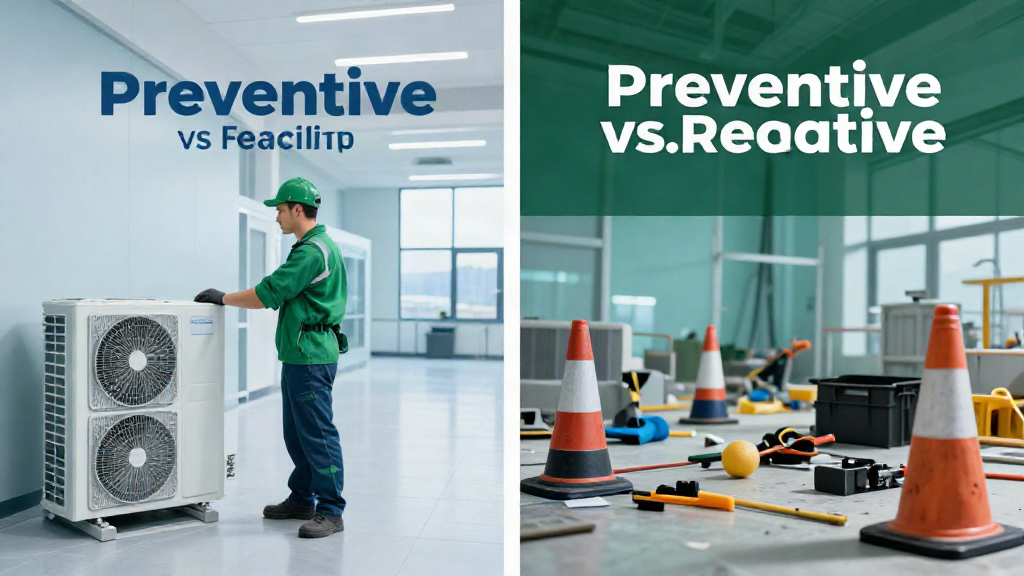
Preventive vs. Reactive Maintenance for Commercial Property

Preventive vs. Reactive Maintenance for Commercial Property

Preventive vs. Reactive Maintenance: Which Really Saves Commercial Property Owners More?

Ask ten commercial property owners how they handle building maintenance and you will hear two very different answers. Some run a scheduled program that keeps systems tuned before anything fails. Others wait for something to break, then call someone to fix it. Both feel like a decision about money. In practice, it is a decision about control, and the numbers behind preventive vs reactive maintenance rarely land where owners expect.

This is not an argument that one approach is always right. Real buildings need both. But understanding what each one actually costs you across a year - in spend, downtime, and equipment life - is what separates a maintenance plan from a maintenance habit.

What preventive and reactive maintenance really mean

Preventive maintenance is any work performed on a schedule or a trigger, before a failure occurs. Filters get changed, belts get inspected, drains get cleared, and equipment gets tested at set intervals. The goal is simple: stop small problems before they become operational ones.

Reactive maintenance is work performed after something stops working. A compressor fails on a Friday afternoon, an elevator call button goes dead, a restroom floods. You respond to the failure, often under time pressure, often at whatever price the situation allows.

The distinction matters because the two are not equally timed. Preventive work is planned and can be bid, batched, and scheduled into low-traffic hours. Reactive work is unplanned, urgent, and priced accordingly.

The cost difference owners feel

The most common assumption is that skipping scheduled maintenance saves money. On a line-item basis, it does - until a failure lands. Then the real cost shows up in three places at once.

First, emergency repairs cost more per hour. After-hours calls, overtime labor, and expedited parts carry a premium over the same job done on a planned visit. Second, a failing system often damages what surrounds it. A small roof leak becomes wet ceiling tiles and inventory loss; a worn belt takes out a motor. Third, you lose the ability to plan. Unplanned spend is the hardest kind to budget, and it always seems to arrive at the worst time of quarter.

A planned program spreads predictable cost across the year. A break-fix approach concentrates unpredictable cost into the worst possible weeks. Most owners find the second pattern harder to manage than the first, even when the annual totals are close.

Downtime is where the gap widens

For most commercial properties, lost operating time costs more than the repair itself. A tenant without air conditioning in July is not just uncomfortable - they are calling their property manager, and their property manager is calling you.

Preventive maintenance reduces downtime in two ways. It lowers how often systems fail, and it shortens how long they stay down when they do, because parts and labor are booked before the problem appears. Reactive maintenance does the opposite on both counts: more failures, each one taking longer to resolve because everything has to be found and scheduled in a rush.

If your building serves customers, tenants, or staff, downtime is the number that should drive the decision - not the invoice for any single repair.

Equipment lifespan: the slowest cost of all

Equipment does not fail on a calendar. It fails on accumulated wear, and scheduled maintenance is what slows that accumulation. Clean coils, balanced systems, and lubricated parts simply last longer than neglected ones.

A reactive approach tends to shorten the life of every major asset you own. You replace compressors, pumps, and motors years earlier than you should, and each early replacement resets the clock on a large capital expense. Over a five- to ten-year horizon, this is often the single largest financial argument for a planned program - larger than any individual repair bill.

How to decide which mix fits your building

Very few properties should be fully preventive or fully reactive. The practical question is where to draw the line. A few factors make the decision clearer:

  • Criticality: How much does it hurt when this system stops? Life-safety, HVAC serving occupied space, and anything touching revenue should lean preventive.

  • Age and condition: Newer equipment rewards scheduled care with long service life. End-of-life assets are better managed with a replacement plan than with endless reactive repairs.

  • Cost of failure: If a failure is cheap and low-impact, run-to-failure is a legitimate strategy. If it is expensive or visible to tenants and customers, plan it.

  • Volume: One building with a handful of systems gets by on ad-hoc work. A portfolio of properties needs a schedule you can actually see.

When to shift toward a planned program

The signal to move toward preventive maintenance is rarely a single big failure. It is a pattern: the same system breaking twice in a season, emergency invoices creeping up, or tenants complaining about comfort and cleanliness before you know there is a problem.

When you spot that pattern, start where failure costs the most. Put the highest-impact systems on a schedule first, measure the change over a quarter, then expand. You do not have to flip everything at once, and you should not.

Why a single-source partner changes the math

The preventive-vs-reactive decision gets harder when every trade is a separate vendor with its own contract, response time, and invoice. Coordination itself becomes a source of downtime - one crew waits on another, and no one owns the schedule.

Handling HVAC, janitorial, electrical, plumbing, landscaping, and lighting under one master contract makes a planned program practical. One partner can sequence preventive work, notice cross-system issues early, and respond when something does fail without you chasing three phone numbers. That is the difference between having a maintenance strategy and simply hoping nothing breaks.

Preventive maintenance is not about spending more. It is about spending on your schedule instead of on an emergency's. For most commercial property owners, the question is not whether to plan - it is which systems to plan first.
SERVICECHANNEL PROVIDERServiceChannel ID: (2000141853)DISPATCH WORK ORDERS STRAIGHT FROM YOUR PORTAL