The 2026 HVAC & Facility Maintenance Calendar for the New York Hub
New York commercial buildings fail on a predictable mechanical schedule because the city's climate delivers four genuinely brutal seasonal transitions, and most equipment doesn't break randomly—it breaks at the exact moment it's asked to work hardest after months of standby. A written 2026 HVAC maintenance calendar converts that predictability from a liability into an advantage, letting facility managers front-load inspections before each loading season rather than scrambling for emergency parts in February or August. What follows is a month-by-month field guide built around the actual mechanical realities of New York commercial stock.
Q1: January–March — Heating Season Defense
January
January is the most dangerous month in a New York mechanical room. Outdoor temperatures routinely drop into the single digits, and any weakness in the heating plant that was tolerable in November becomes a crisis. Priority tasks:
- Freeze protection audit: Inspect all rooftop unit coil freeze stats, verify setpoints (typically 35°F leaving air), and confirm low-ambient lockout controls are programmed and tested. A failed freeze stat on a rooftop AHU can destroy a coil over a single overnight — replacement cost and lead time in current supply conditions make prevention non-negotiable.
- Steam trap survey (Con Edison steam buildings): Survey all accessible steam traps with an ultrasonic gun and infrared camera. Failed-open traps vent live steam to the return, driving up Con Ed steam bills and starving radiation downstream. Failed-closed traps create cold zones and wet hammer. Log every trap with pass/fail status; replace failed units before the February peak.
- Boiler controls and safeties: Test high-limit aquastats, low-water cutoffs (manual reset and auto), and flame-failure controls. Verify combustion analysis records are current; dirty burners operating rich waste fuel and accelerate heat exchanger wear.
- Perimeter radiation and unit ventilator valves: Physically stroke all two-way and three-way control valves on perimeter fan coil units and unit ventilators. Valves that stick closed in January leave tenants in cold perimeter offices; valves stuck open create simultaneous heating and cooling that inflates energy use.
- BAS sequence verification: Confirm heating sequences in the building automation system match current design intent. Economizer dampers should be in winter mode; mixed-air low-limit controls must be active.
February
February extends January's freeze risk while adding the first scheduling work for cooling season startup, which must begin now for large chiller plants.
- Water line heat trace inspection: Verify all electric heat trace cables on exposed domestic water and condensate lines are energized and alarming correctly. A failed heat trace on a rooftop condensate drain is a slip-and-fall waiting to happen.
- Filter change (Cycle 1 of 4): Replace or clean all air handler filters on schedule regardless of visual appearance. Pressure drop across a loaded filter increases fan energy draw and can trigger freeze conditions by reducing airflow across cooling coils left partially charged.
- Belt and bearing inspection: Inspect all V-belt drives for wear, glazing, and proper tension. Check fan and pump bearings with a vibration pen or ultrasonic tool. A seized bearing in February means emergency service at premium rates.
- Chiller pre-season planning: Issue RFPs or schedule your chiller contractor for spring startup. Chillers require leak checks, oil analysis, tube inspection, and controls calibration — book crews now before April backlog hits.
March
March is transitional and deceptive. A warm week tempts operators to start cooling early; a cold snap the following week freezes coils in units taken out of heating mode prematurely.
- Economizer functional test: Cycle all economizer dampers through full stroke, verify actuator torque, and test the high-limit enthalpy or dry-bulb controls. Local Law 87 retro-commissioning requirements make economizer documentation essential; a damper stuck closed wastes enormous free cooling capacity across the shoulder season.
- Hydronic system inspection: Check expansion tanks for waterlogging, inspect air separators, and verify glycol concentration in any systems with freeze exposure. Riser balancing valves should be confirmed in winter position before changeover.
- Steam system end-of-season log: Document steam consumption data from Con Ed bills against HDD (heating degree days) to establish a baseline. Anomalies flag trap failures or sequence errors before next heating season.
Q2: April–June — Cooling Season Preparation
April
April is the most important month on the calendar. Every dollar spent here prevents a dollar of emergency cost in July.
- Cooling tower startup and Legionella compliance: Per NYC Health Code and the building's Water Management Plan, conduct a full tower cleaning, basin disinfection, and startup biocide treatment before initial operation. Retain all water treatment records, contractor certifications, and pre-startup inspection reports — these are required documents under city law. Inspect fill media, drift eliminators, float valves, and basin heaters. Schedule cooling tower inspections with a certified water treatment firm.
- Chiller startup: Complete refrigerant leak check (document per EPA Section 608), oil analysis, eddy-current tube inspection if due, controls calibration, and capacity test. Verify refrigerant charge and log superheat and subcooling at design conditions.
- Condenser coil cleaning: Clean all air-cooled condenser coils with a low-pressure fin comb and non-acidic coil cleaner. A coil with 20% fin blockage raises condensing pressure and cuts capacity significantly — on a 95°F design day, that margin disappears.
- Filter change (Cycle 2 of 4): Replace filters entering cooling season with the correct MERV rating for each system.
May
- BAS cooling sequence commissioning: Verify chilled water supply temperature resets, cooling tower approach setpoints, and demand-limiting sequences. Local Law 97 carbon compliance depends on efficient part-load operation — a chiller running at fixed 44°F supply when reset to 48°F would cut compressor energy materially.
- Drain pan and condensate inspection: Inspect all AHU and FCU drain pans for algae, scale, and standing water. Prime condensate traps. A clogged drain in June floods ceilings and triggers mold remediation.
- Roof access scheduling: For landmark buildings or high-rises requiring crane or hoist access, confirm all summer access windows now. Scheduling lead times for rooftop equipment work in Manhattan can run six to ten weeks.
June
- Full cooling load commissioning run: Verify system performance at near-design conditions on the first hot day. Document chiller kW/ton, cooling tower approach, and supply air temperatures. Deviations flag fouled tubes or refrigerant issues before peak season.
- Water-source heat pump survey: In buildings with WSHP loops, verify loop temperature control, pump operation, and individual WSHP refrigerant circuits. A failed loop pump in June takes down every zone on that loop simultaneously.
Q3: July–September — Peak Cooling and Mid-Season Checks
July
- Cooling tower mid-season blowdown and water treatment audit: Review biocide dosing logs, conductivity readings, and tower basin cleanliness at the mid-season mark. Legionella risk peaks in warm weather; documentation gaps create regulatory and liability exposure.
- Belt and bearing mid-season check: Cooling tower fan motors and chilled water pump bearings accumulate hours rapidly in summer. A bearing failure on a cooling tower fan in July degrades condenser approach and loads the chiller.
- BAS alarm audit: Review all active and suppressed alarms in the BAS. Suppressed alarms are the most dangerous items in any mechanical room — operators silence nuisance alarms and then forget genuine faults.
August
- Filter change (Cycle 3 of 4): High-occupancy summer loading in office and retail buildings accelerates filter loading. Skipping this change increases fan energy and can cause coil icing on low-load nights.
- Refrigerant leak re-check: Heat and vibration over the summer loosen fittings. A mid-season leak check on all DX systems and chillers catches loss before it becomes an EPA reporting event.
- Local Law 97 mid-year energy review: Pull interval meter data and compare to the building's carbon intensity target. If the building is trending over its 2026 limit, operational adjustments (supply air temperature reset, chiller staging, lighting controls) must be made now, not in December.
September
- Heating season pre-planning: Issue purchase orders for boiler parts, steam trap replacements, and glycol. Supply chain lead times for specialty steam hardware in New York remain long. Ordering in September for October startup is the minimum; ordering in October for October startup is a gamble.
- Economizer shoulder-season test: Test economizer operation at mixed conditions. September days frequently offer genuine free cooling opportunity that BAS sequences miss if damper controls are miscalibrated.
Q4: October–December — Heating Startup and Year-End Close
October
- Boiler startup and combustion tuning: Inspect burners, heat exchangers, and flue connections. Conduct combustion analysis; document efficiency. Heating readiness must be complete by October 15 in New York — a heating failure after that date triggers tenant complaints, lease obligations, and potential HPD violations.
- Cooling tower winterization: Drain basin or enable basin heaters per design, install freeze protection covers, and shut down chemical feed systems. Retain end-of-season water treatment certifications.
- Chiller winter layup: Drain or glycol-protect as required, cover condenser coils on rooftop units, and engage low-ambient lockouts.
- Filter change (Cycle 4 of 4): Enter heating season with clean filters. High static pressure across dirty filters forces furnaces and AHUs to work harder against the winter airflow load.
November
- Steam system full survey: With the heating system now under load, conduct a full steam trap survey while traps are operating. Failures found now can be repaired before January's peak demand. Inspect radiator supply valves, air vents, and thermostatic elements on all accessible radiation.
- Riser balancing verification: In high-rise hydronic buildings, verify differential pressure across balancing valves at multiple floors. Unbalanced risers create hot upper floors and cold lower floors — a perennial tenant complaint in pre-war and mid-century Manhattan towers.
- BAS heating sequence verification: Confirm heating valve sequences, outdoor air reset curves, and night setback schedules. A misconfigured night setback that drops occupied-space temperatures below 55°F risks pipe freezing in exterior walls.
December
- Annual PM documentation close-out: Compile all service records, water treatment logs, filter change logs, refrigerant records, and BAS trend data into a single annual file. Local Law 87 submittals and Local Law 97 compliance reporting require organized, dated maintenance records.
- Freeze protection final walk: Inspect all rooftop units, exposed piping, and heat trace circuits before the deep-freeze window opens in January. Replace any heat trace that failed continuity testing.
- Equipment inventory and parts stocking: Confirm critical spare parts are on hand: common steam trap repair kits, motor starters, belts, bearings, and refrigerant cylinders. An emergency call at 2 a.m. in January is less catastrophic when the parts are already in the mechanical room.
What a Compliant PM Calendar Actually Saves
A written, executed PM calendar doesn't just prevent breakdowns — it extends the service life of capital equipment that is genuinely expensive to replace. Chillers, cooling towers, and large boilers are multi-decade assets when properly maintained; they become five-to-ten-year liabilities when run to failure. Steam trap surveys pay for themselves in reduced Con Ed steam consumption. Economizer verification enables free cooling hours that reduce chiller runtime. Proper water treatment prevents tube fouling and Legionella liability simultaneously. And for buildings subject to Local Law 97, documented efficient operation is a compliance argument — unplanned equipment failures that force extended inefficient operation cannot be explained away in a carbon report.
Facility managers who execute this calendar also build the maintenance history that supports capital planning: a ten-year chiller that has been properly logged and serviced is a defensible asset; one with gaps in its service record is a budget uncertainty.
Frequently Asked Questions
Q: How often should steam traps be surveyed in a Manhattan building on Con Edison steam? A: At minimum once per heating season, ideally in November when traps are under full load. High-rise buildings with large trap populations benefit from a second survey in January. Failed-open traps are often the single largest controllable energy cost in a pre-war building.
Q: What documentation do I need to retain for cooling tower compliance in New York City? A: You must retain your Water Management Plan, pre-startup inspection records, biocide treatment logs with dates and dosages, water testing results, and contractor certifications. These must be available for inspection by the NYC Department of Health. Gaps in documentation are treated as seriously as gaps in actual treatment.
Q: When does Local Law 97 start imposing carbon penalties, and how does my PM calendar affect compliance? A: The first compliance period covering calendar year 2024 is already in effect, with reports due in 2025. 2026 operates under the same initial limits. A well-executed PM calendar supports compliance by keeping equipment operating at design efficiency — oversized boilers running at low fire, economizers disabled, or chillers with fouled tubes all increase carbon intensity beyond what the equipment's nameplate would suggest.
Q: How early should I book crews for rooftop or crane-access work on a Manhattan high-rise or landmark building? A: Six to ten weeks is a realistic minimum for permitted crane lifts or hoist access. Landmark buildings with Landmarks Preservation Commission requirements may need additional lead time for approval coordination. April and October are peak scheduling months — plan August for fall rooftop work and February for spring rooftop work.
Q: Can MetroKleen | MKMaintX handle multi-site PM programs across the New York metro area and beyond? A: Yes. MKMaintX serves Manhattan, Brooklyn, Queens, Long Island, Westchester, and the Hudson Valley, with national service capabilities across 35+ states. Multi-site clients can consolidate vendor management, standardize PM documentation, and access centralized reporting. Call 1-888-669-5808 or visit mkmaintx.com to discuss a custom maintenance program for your portfolio.
Get a Quote for Your Facility
Tell us where your building is and we'll call you back within 2 business hours. No obligation.
Subscribe to Updates
Get facility maintenance insights delivered
Join our newsletter for expert tips, industry news, and company updates from the MetroKleen | MKMaintX team.
Services That Cover This Work
MetroKleen | MKMaintX handles every trade under one contract — so the fix in this article and the next one call come from the same team.
Preventive programs, RTU & chiller service, 24/7 emergency repair
VIEW SERVICENightly cleaning, day porters, floor care, multi-site programs
VIEW SERVICEPrecision HVAC, humidity control, GMP-compatible cleaning
VIEW SERVICEPanels, wiring, code compliance, emergency power
VIEW SERVICEPipe repair, drain cleaning, backflow prevention
VIEW SERVICELED retrofits, fixture service, emergency lighting
VIEW SERVICELOCAL SERVICE PAGES
Need this work handled? Free assessment, no minimum contract.
Related Posts
AI SELECTED
The 2026 HVAC & Facility Maintenance Calendar for the New Jersey Hub
A month-by-month 2026 HVAC maintenance calendar for New Jersey commercial facilities—boilers, chillers, cooling towers, and more.
12 min read
The 2026 HVAC Maintenance Calendar for the New England Hub
A month-by-month 2026 HVAC maintenance calendar for New England commercial facility managers — covering Boston, Manchester NH, Hartford CT, Providence RI, and Worcester. Quarterly PMs, seasonal changeover, freeze protection, cooling tower startup, boiler service, and more.
12 min read
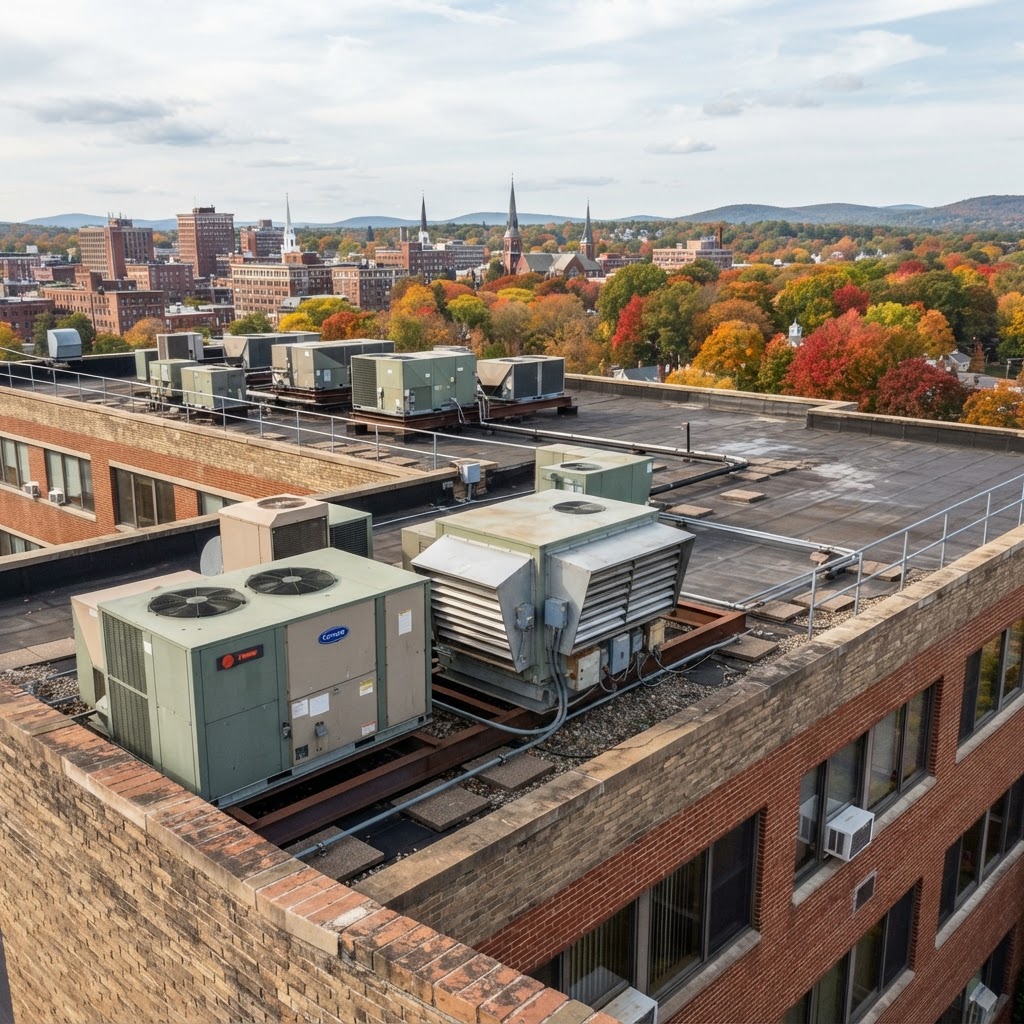
The 2026 HVAC & Facility Maintenance Calendar for the Massachusetts Hub
A month-by-month 2026 HVAC maintenance calendar for Massachusetts facility managers — boilers, chillers, steam, coils, and compliance all on one schedule.
11 min read
Comments (0)
No comments yet. Be the first to comment!