The 2026 HVAC & Facility Maintenance Calendar for the New Hampshire Hub
New Hampshire commercial buildings fail on a predictable mechanical schedule because the climate imposes extreme thermal swings, compressed seasons, and back-to-back stress events that catch unprepared systems mid-transition. A boiler that sat idle all summer, a freeze stat never tested before November, or an economizer hood packed with ice from a January storm — these are not random failures. They are calendar failures. A written 2026 HVAC maintenance calendar transforms reactive calls into scheduled interventions, and for facilities in Keene, Lebanon, Hanover, or any rural campus without in-house engineering staff, it is the maintenance record.
Q1: January, February, March — Deep Winter Survival Mode
January
January in New Hampshire is not the time to discover problems — it is the time to confirm that October and November preparation held. Your primary January tasks are verification, not installation.
- Combustion efficiency check on boilers and furnaces. Flue gas analysis should confirm CO₂ and O₂ ratios are within manufacturer spec. Dirty heat exchangers, degraded burner nozzles on oil systems, or propane pressure drops from cold tank temperatures will show here. Skip this and you are running on assumption during the coldest 30 days of the year.
- Freeze stat and low-ambient lockout confirmation. Rooftop units serving perimeter zones must have freeze stats tested under actual cold-air conditions. If a freeze stat trips nuisance-free but fails to trip under genuine coil-freeze conditions, you will lose the coil — a four-figure replacement mid-winter.
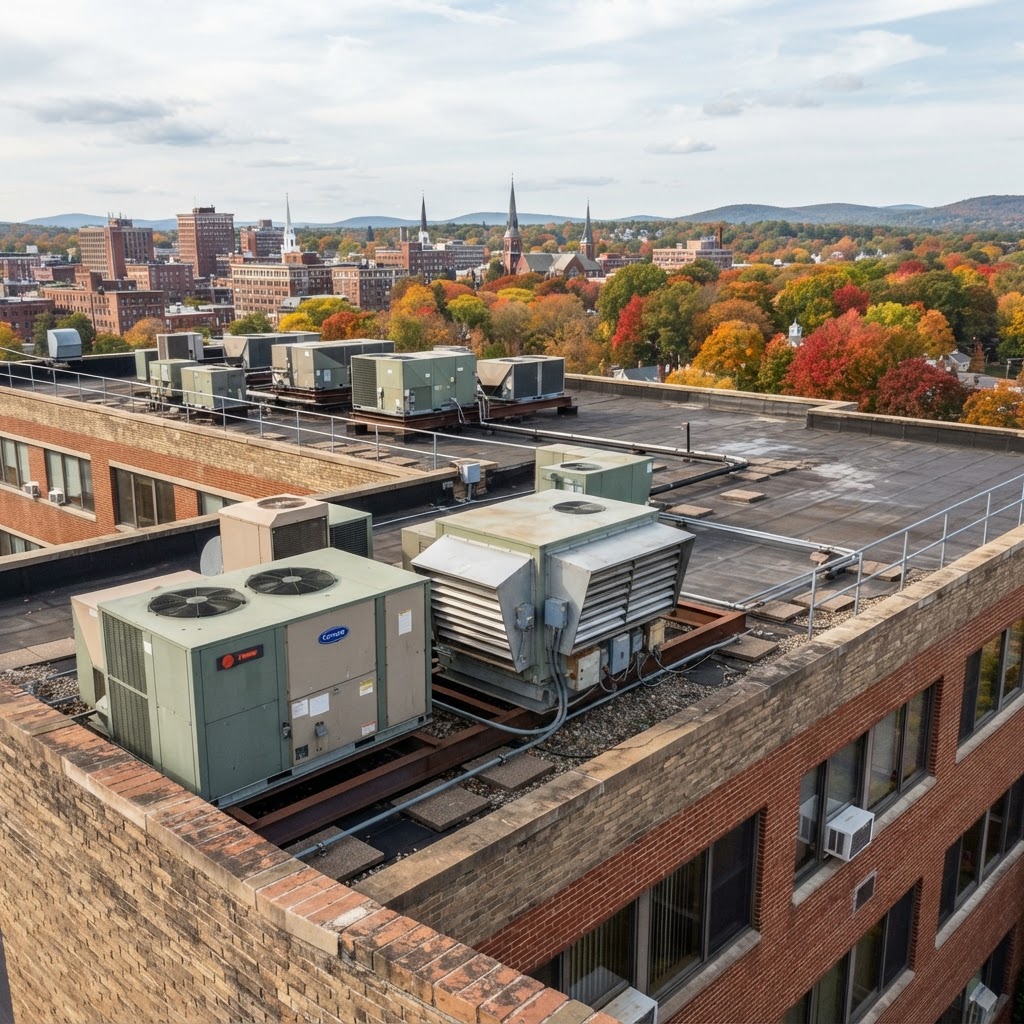
- Roof drain and curb inspection after snowfall events. Ice dams over economizer hoods restrict outdoor air dampers and cause units to recirculate exhaust. Snow-load accumulation on curbs can distort sheet metal and compromise weatherstripping. Assign this as a post-storm checklist item, not a quarterly PM line.
- BAS heating sequence verification. Confirm that supply air temperature resets, morning warm-up sequences, and night setback recovery are functioning as programmed. A mis-configured reset schedule will run heating equipment continuously at full fire.
- Filter inspection on all air handlers. High static pressure from loaded filters in January forces supply fans to work harder in cold-start conditions, accelerating belt wear and bearing fatigue.
February
- Belt tension and bearing inspection on all AHU and RTU fan assemblies. Cold ambient temperatures cause belts to stiffen and lose tension; what was acceptable in October may be slipping in February. Listen for squealing on startup and measure amp draw against nameplate.
- Glycol loop concentration verification. Glycol systems protecting heating coils, heat recovery wheels, and sprinkler-adjacent mechanical rooms should be tested with a refractometer. Dilution from coil leaks or makeup water additions can reduce freeze protection below design intent.
- Condensate drain pan inspection on all air handlers. Even in heating mode, drain pans can accumulate debris and support microbial growth. Healthcare and laboratory facilities in Hanover and Lebanon must treat this as an IAQ item, not a deferred task.
- Emergency generator load test for critical facilities. Hospitals, dialysis centers, and laboratory buildings on continuous reheat cannot tolerate heating-plant failure. Confirm generator transfer and that boiler control circuits are on emergency power.
March
- Pre-season cooling readiness audit begins here, not in May. Order compressor contactors, capacitors, and refrigerant if lead times are long. NH suppliers can backorder common components in spring.
- Economizer actuator and damper inspection. March brings freeze-thaw cycles that seize damper linkages. Test full stroke on all economizer dampers before free-cooling season begins.
- Water treatment system check for any closed-loop hydronic systems. Inhibitor levels, pH, and conductivity should be verified after a full heating season of circulation.
- Boiler low-water cutoff test and blowdown. Before reducing firing frequency, confirm safety controls function correctly. This is also the time to schedule a boiler inspection if your jurisdiction requires annual certification.
Q2: April, May, June — Shoulder Season and Cooling Preparation
April
April is New Hampshire's most dangerous maintenance month. The heating system is still needed — snow events through mid-April are common — but facilities managers begin standing down their vigilance. Do not stand down.
- Dual-fuel and oil-heat boiler seasonal service. If the system will be mothballed for summer, perform a full nozzle, filter, and strainer inspection now. Fuel tanks should be topped off or stabilized to prevent condensation and microbial growth in oil tanks over summer.
- Propane system and regulator inspection. Regulator freeze-up is a winter event, but annual inspection of regulators, vaporizers, and line traps belongs in the spring service window.
- Cooling tower startup preparation. Legionella risk management requires that cooling tower basins be inspected, cleaned, and disinfected before first fill. This is not optional for healthcare or educational facilities. Confirm your water treatment vendor is scheduled.
- Variable frequency drive inspection on all HVAC motors. Check drive parameter settings, DC bus capacitors, and cooling fans inside VFD enclosures. A failed VFD in June during a heat event is an emergency.
May
- Full refrigerant circuit inspection on all rooftop units and split systems. Check for oil staining at fittings, measure superheat and subcooling, and pressure-test any circuits that showed low charge in the prior cooling season. Refrigerant leak checks at this stage prevent mid-summer failure.
- Condenser coil cleaning. Fin blockage from a full year of cottonwood seed, debris, and surface oxidation must be removed before the cooling season. A dirty condenser coil raises head pressure, increases compressor lift, and reduces capacity. For NH's compressed July-August peak, you need full capacity available from day one.
- Cooling tower fill, chemical treatment baseline, and Legionella sampling per your water management plan.
- BAS cooling sequence commissioning check. Verify that economizer lockout setpoints, compressor staging, and supply air temperature controls are programmed correctly before ambient temperatures climb.
June
- Chiller startup procedure (for facilities with central chilled water): oil pressure check, refrigerant charge verification, evaporator and condenser waterside inspection, cooling tower approach temperature baseline.
- Drain pan and condensate line flush on all cooling coil sections. Algae growth in drain pans begins as soon as latent cooling starts. Healthcare facilities must treat pans with biocide tablets.
- Occupant comfort baseline survey for office, education, and retail facilities. Identify complaints before peak season rather than reacting in August.
Q3: July, August, September — Peak Cooling and Heating Transition
July
New Hampshire's cooling peak is short and intense. July and August are the only months where mechanical cooling is the primary load driver.
- Monthly filter inspection during peak cooling. High occupancy and maximum outdoor air increase filter loading. A clogged filter in July reduces cooling coil airflow and causes coil icing — a common misdiagnosed refrigerant call.
- Condenser coil re-inspection mid-season. One cleaning in May is not sufficient for high-debris environments. Industrial and food-service facilities with grease or airborne particulate need a mid-season clean.
- BAS demand response and peak load management verification. For facilities enrolled in utility demand response programs, confirm the BAS curtailment sequences are active.
August
- Cooling tower blowdown and biological monitoring mid-season. Heat and evaporation concentrate minerals and increase Legionella risk. Review your monthly water treatment logs.
- Belt and bearing inspection on all air handlers. Peak cooling season imposes maximum runtime on fan assemblies. Catch wear before the heating transition adds additional stress.
- Begin developing the fall mechanical transition schedule. Order boiler nozzles, oil filters, belt sets, and any components identified in the spring audit.
September
September is the single most important PM month on the New Hampshire calendar. The window between summer shutdown and first heating demand is narrow — often just six weeks.
- Full boiler and furnace annual service: combustion analysis, heat exchanger inspection, burner assembly cleaning, nozzle replacement (oil), igniter and flame rod inspection, gas valve and fuel train inspection (propane and natural gas). A boiler that fails its first cold startup in October will fail during peak demand.
- Oil tank inspection and fill. Confirm tank integrity, gauge accuracy, and fuel quality. Water at the bottom of an oil tank will freeze in lines before December.
- Rooftop unit heating mode commissioning. Switch all RTUs to heating mode in September while ambient temperatures still allow safe rooftop access. Test electric heat strips, gas heat sections, and hot gas reheat circuits.
- Economizer damper full-stroke test and control calibration. The economizer will be your free-cooling workhorse in October. Confirm damper moves full stroke, actuator is tight, and the BAS enthalpy or dry-bulb control logic is correctly set.
- Freeze stat set-point verification. Every air handler with a heating coil in the outdoor air stream must have its freeze stat set-point confirmed before the first sub-freezing night.
Q4: October, November, December — Hard Heating Season Onset
October
- Low-ambient lockout testing on all cooling equipment. Confirm that compressors are locked out below design ambient (typically 55°F for standard equipment) and that crankcase heaters are energized.
- Glycol system recharge if concentration was found low in February.
- Final cooling tower winterization: drain basins, shut down pumps, blow out waterside piping if not heated, remove and store fill sections if required.
- Roof drain inspection before freeze season. Blocked roof drains combined with early snowfall create ponding that freezes over drains and forces water through membrane seams.
November
- Full heating system verification under load. The first sustained cold snap of the season is not the time to find a failed zone valve or a seized circulator pump.
- Humidification system startup for healthcare and laboratory facilities. Steam or evaporative humidifiers serving critical spaces must be cleaned, descaled, and operationally tested before indoor RH drops below the 30% threshold that creates static discharge and mucosal risk.
- BAS night setback and unoccupied heating verification. Confirm that unoccupied setpoints are not so low that pipes in exterior mechanical rooms are at risk.
- Monthly filter change across all systems entering heating season high-runtime.
December
- Post-storm roof and curb inspection protocol active. Assign specific personnel and document inspections after each significant snow or ice event.
- Combustion safety verification: CO detector testing in mechanical rooms and occupied spaces. Cracked heat exchangers in gas-fired equipment are most likely to manifest as CO events in December when systems run continuously.
- Year-end PM documentation review. Every completed service, filter change, repair, and reading should be consolidated into the facility maintenance record. For rural NH facilities without engineering staff, this file is the institutional memory of the building.
- Plan and schedule Q1 2027 services — order components with long lead times in December.
What a Compliant PM Calendar Actually Saves
A written, executed maintenance calendar does not guarantee zero breakdowns. What it does is change the failure profile of your building's mechanical systems. Planned replacement of a $40 burner nozzle in September eliminates the scenario where a failed nozzle triggers a no-heat emergency call at 2 a.m. in January. Annual condenser coil cleaning extends compressor life by reducing the discharge pressure the compressor must work against over thousands of hours. Glycol concentration testing prevents a coil freeze that can rupture copper headers and require a complete coil replacement — weeks of lead time for a custom coil on a large AHU.
For commercial boilers, documented annual service supports warranty claims and insurance inspections. For healthcare and higher-education facilities in Hanover and Lebanon, a complete PM record is a compliance document reviewed by accreditation bodies. For any facility with a deferred maintenance backlog, the calendar is the framework for prioritizing capital expenditures before emergency drives the decision.
Asset life extension is real and measurable at the equipment level: chillers that receive annual tube cleaning and water treatment routinely reach 20-plus years; those that do not often require retubing or replacement in 12-15. Rooftop units receiving quarterly PM consistently outlast neglected units by five or more years on identical equipment families.
Frequently Asked Questions
Q: How often should commercial HVAC filters be changed in a New Hampshire facility?
A: For most commercial applications, quarterly filter changes are the minimum. During peak heating (November through February) and peak cooling (July-August), monthly inspection with change-as-needed is appropriate. Healthcare, laboratory, and high-occupancy facilities should inspect monthly year-round. High-MERV filtration in healthcare settings requires more frequent changes because increased resistance builds faster.
Q: When should I schedule my boiler annual service in New Hampshire?
A: The ideal window is September, after cooling season ends and before first heating demand. This gives your service provider access to equipment that is off, time to order parts if any are found deficient, and ensures the system is fully commissioned before the October-November heating onset. Scheduling in October or November means you are racing the weather.
Q: Do rooftop units in New Hampshire need low-ambient lockout controls?
A: Yes. Standard scroll and reciprocating compressors are not designed to operate in cooling mode below approximately 55°F ambient without low-ambient controls. In New Hampshire, outdoor temperatures drop below this threshold as early as October. Without low-ambient lockout, compressors can flood with liquid refrigerant on startup, causing catastrophic bearing failure. Crankcase heaters must also be confirmed energized at the start of each heating season.
Q: What is the most commonly skipped PM task that causes the most expensive failures in NH commercial buildings?
A: Freeze stat testing is consistently the most overlooked item and produces some of the most expensive single-event failures. A freeze stat that fails to trip under genuine coil-freeze conditions allows a heating coil to freeze solid, rupturing the coil and flooding the air handler. Replacement costs, water damage remediation, and downtime combine to make this the highest-consequence skipped task in the heating-dominant New Hampshire climate.
Q: Can MetroKleen | MKMaintX service facilities outside New Hampshire?
A: Yes. MKMaintX operates across 35-plus states. Whether your portfolio includes a single Manchester office building or a multi-state campus network, the same documented PM calendar framework applies. Contact the team at 1-888-669-5808 or visit mkmaintx.com to discuss a customized maintenance agreement for your facilities.
Get a Quote for Your Facility
Tell us where your building is and we'll call you back within 2 business hours. No obligation.
Subscribe to Updates
Get facility maintenance insights delivered
Join our newsletter for expert tips, industry news, and company updates from the MetroKleen | MKMaintX team.
Services That Cover This Work
MetroKleen | MKMaintX handles every trade under one contract — so the fix in this article and the next one call come from the same team.
Preventive programs, RTU & chiller service, 24/7 emergency repair
VIEW SERVICENightly cleaning, day porters, floor care, multi-site programs
VIEW SERVICEPrecision HVAC, humidity control, GMP-compatible cleaning
VIEW SERVICEPanels, wiring, code compliance, emergency power
VIEW SERVICEPipe repair, drain cleaning, backflow prevention
VIEW SERVICELED retrofits, fixture service, emergency lighting
VIEW SERVICELOCAL SERVICE PAGES
Need this work handled? Free assessment, no minimum contract.
Related Posts
AI SELECTED
The 2026 HVAC Maintenance Calendar for the New England Hub
A month-by-month 2026 HVAC maintenance calendar for New England commercial facility managers — covering Boston, Manchester NH, Hartford CT, Providence RI, and Worcester. Quarterly PMs, seasonal changeover, freeze protection, cooling tower startup, boiler service, and more.
12 min read
The 2026 HVAC & Facility Maintenance Calendar for Manchester
A month-by-month 2026 HVAC maintenance calendar built for Manchester NH's heating-dominant climate — covering boilers, chillers, freeze protection, economizers, and seasonal changeover.
9 min read
The 2026 HVAC & Facility Maintenance Calendar for the Massachusetts Hub
A month-by-month 2026 HVAC maintenance calendar for Massachusetts facility managers — boilers, chillers, steam, coils, and compliance all on one schedule.
11 min read
Comments (0)
No comments yet. Be the first to comment!